
Journaling every day is powerful - Part 2: Going further


Introduction
Periodic journaling is a simple, yet powerful practice. It can help you declutter your mind and grow in all aspects of your life. In this series, I want to share some ideas about periodic journaling and writing daily notes. Together, we'll explore the why, the what and the how.
Through this series, I aim to motivate you to try this technique for yourself. Without exaggerating, I can say that journaling has changed my life for the better.
I'll tell you why I rely on periodic journaling. It is a critical practice for my well-being, productivity, and growth. I'll also explain why and how I use periodic reviews to keep improving.
 Sebastien Dubois
Why and How to Combine Journaling, Learning, and Knowledge Management
It's pretty obvious that the education system is broken. We all need to take ownership of our knowledge and invest in ourselves. As a lifelong learner, my Personal Knowledge Management (PKM) system is very important to me. It serves as my second brain.
Note-taking and PKM help better engage with content that we explore, internalize and retain more knowledge. The list of benefits doesn't stop there. Writing is thinking. Whenever I learn something, I express it using my own words. This allows me to better internalize ideas. When I do so, I take rough notes. Those don't have to be perfect; it doesn't matter. What matters is that the ideas are there and that my future self can understand those again later. In the PKM ecosystem, those are often fleeting notes and literature notes. Check out the two articles of Nick Ang to learn more about note types in a PKM.
There's more to it. Describing my discoveries as part of my journal allows me to maintain context about what I was doing around the time I learned something. This contextual information is very useful. My daily notes as the main entry point into my personal knowledge base. Here's how I conceptualize this:
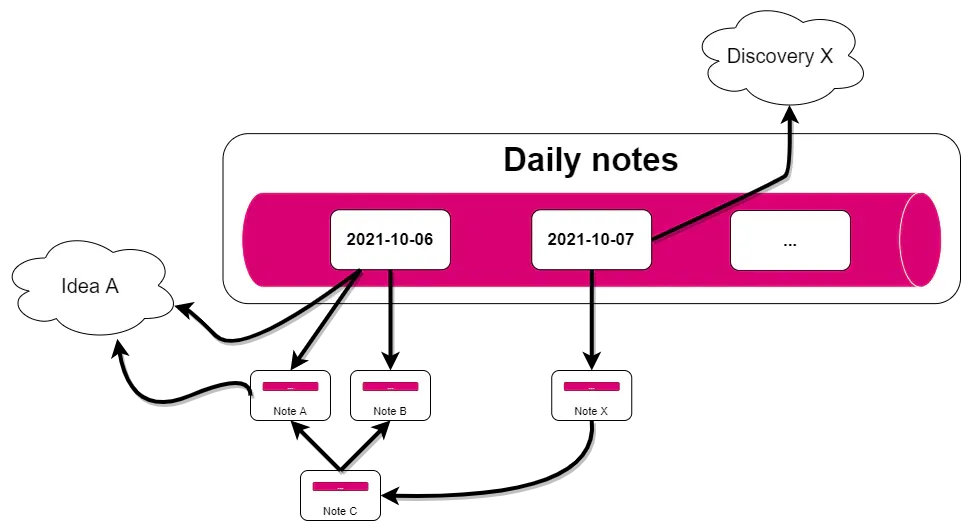
Whenever I take daily notes, I write down thoughts, ideas, or discoveries that I've made. That information is part of a clear timeline. And the surrounding notes capture the context. I can re-discover what frame of mind I was in, what my goals were, when and where I first heard about something, etc.
As I review, refine, condense and crystallize those rough notes, they ultimately turn into more permanent ones (atomic ones!). They integrate my personal knowledge base. When that transition occurs, I can link those notes to their origin in my daily notes. Digital tools like Obsidian and Roam make this very easy. But it is also doable using methods like Zettelkasten.
Sebastien Dubois
This means that I have end-to-end traceability about the knowledge in my second brain. I find this particularly empowering; especially as a content creator.
Over time, building a second brain helps to connect new ideas to older ones. This in turn reinforces learnings. By linking ideas together, we can create more connections in our minds. This allows us to apply ideas from one field into another, and derive new thoughts and ideas. Wonderful ❤️
The relationship between Journaling, Personal Health, and Growth
Daily notes are especially useful to be mindful about our own well-being. For instance, by evaluating our stress levels and keeping note of stressors in our lives, we can identify patterns. By exploring those, we can then think about counter-measures to live a more peaceful life. This works with other health issues as well.
A while ago I noticed a pattern with my 11yo son. He was regularly asking me to play video games. But, each time, I was too busy. There was always something I needed to finish first. He waited a bit, then asked again, but I was still busy. I would say "I'll be there in a few minutes", and always kept being late. Out of frustration, he would then annoy his sister and make her mad. This led to anger and caused a lot of stress at home. He needed my attention, and I wasn't present enough. In fact, all I needed to do was to plan ahead and adjust my work schedule to be more available for him. Since I did that, we had much less drama. Without my journal, I would not have noticed the pattern. But since I wrote regularly and had context, my notes helped me understand what I was doing wrong. It may be a silly example, but I have countless other stories where note-taking and journaling have helped me.
Journaling is great for personal development and can help us grow as individuals. Our journal is a safe place to express ourselves. Writing in the journal really means conversing with ourselves. Moreover, it also helps to better take care of our health.

How to leverage Journaling for Productivity
I must confess: I'm a productivity freak (I know, it's bad 😂). Journaling is actually a core tenet of my personal productivity system. Let me explain why.
At the end of the day, as part of my "shut down" routine, I take a few moments to review my day, and think about my goals for the next. The review gives me the opportunity to identify the reasons for which I couldn't achieve my goals, and to think about possible improvements in my workflow. Done regularly, this helps me be more reasonable. It prevents me from ending the week wondering why I couldn't get anything meaningful done. This keeps my inner critic in check. On the other hand, thinking and planning ahead helps me remove anxiety for the next morning. I enjoy starting a new day, already clear on what I want to achieve and why. This alone is very powerful.
Sebastien Dubois
One book that I can't stop recommending is Make Time by Jake Knapp and John Zeratsky. The main point is to define one highlight for the day; a single thing that you want to progress towards and put most of your energy into. This helps to reduce the noise and better focus our attention.
Sebastien Dubois
We make more tangible progress on focusing on less:

By the way, that is the core idea shared by Essentialism, an awesome book written by Greg McKeown that I also recommend.
The list of goals for the next day is just a plan for myself. The list isn't set in stone. I usually course-correct as the day goes by. Nothing wrong with that.
But it doesn't stop there.
Why Periodic Reviews are Awesome to Track Progress and Plan Ahead
Daily notes and daily reviews make a huge difference for personal development and productivity. If you want to go to the next level though, you should consider additional types of periodic notes: weekly, monthly and yearly.
Sebastien DuboisMy personal productivity system relies on regular reviews, inspired by truly agile approaches and innovation principles:
- Think
- Plan
- Act
- Review
- Adapt
- Repeat
Sebastien DuboisAs I've mentioned, I try to plan my days ahead of time. I actually do the same for my weeks, months, and years. I sit down every week/month/year and think ahead. My aim is to align my actions with my short, mid, and long-term goals. Long-term goals are my north star.
To ensure that I don't deviate too much for too long, I also regularly review my notes. I summarize my achievements, key learnings, and check if I actually made progress towards my goals.
This ceremony helps me to stay focused and to keep improving. Usually, it's also the moment where I realize that I'm often overly optimistic about what I can achieve in any given period of time. It's humbling, but also interesting to set more realistic expectations for the future. As Amara’s Law states:
Most people overestimate what they can achieve in a year and underestimate what they can achieve in ten years. — Roy Amara
Here is the template that I use for weekly, monthly, and yearly notes/reviews:
- Goals: what I would like to achieve
- Achievements: what I actually managed to do
- Challenges: difficulties I've faced
- Discoveries: wonders I've discovered
- Gratitude: what I'm grateful for
Again, quite basic and approachable. My goal is not to write an essay each week/month/year, but to surface what's essential for me.
Naming scheme for Periodic Notes
In case you're interested, here's the naming scheme I use for my periodic notes:
- Daily: yyyy-MM-dd (e.g., 2021-10-07)
- Weekly: yyyy-Wxy (e.g., 2021-W40)
- Monthly: yyyy-MM (e.g., 2021-10)
- Yearly: yyyy
Simple, yet effective. To order things, I also create folders
Tools I use for Periodic Notes
Tools are not what I want to focus on in this article. But maybe you'd like to know what I use for digital note-taking and to maintain my PKM system. Currently, I've settled on Obsidian along with the Periodic Notes community plugin.
The Periodic Notes plugin is useful because it can be used to quickly create periodic notes according to pre-defined day/week/month/year templates. This helps me avoid wasting time copying and pasting things around:
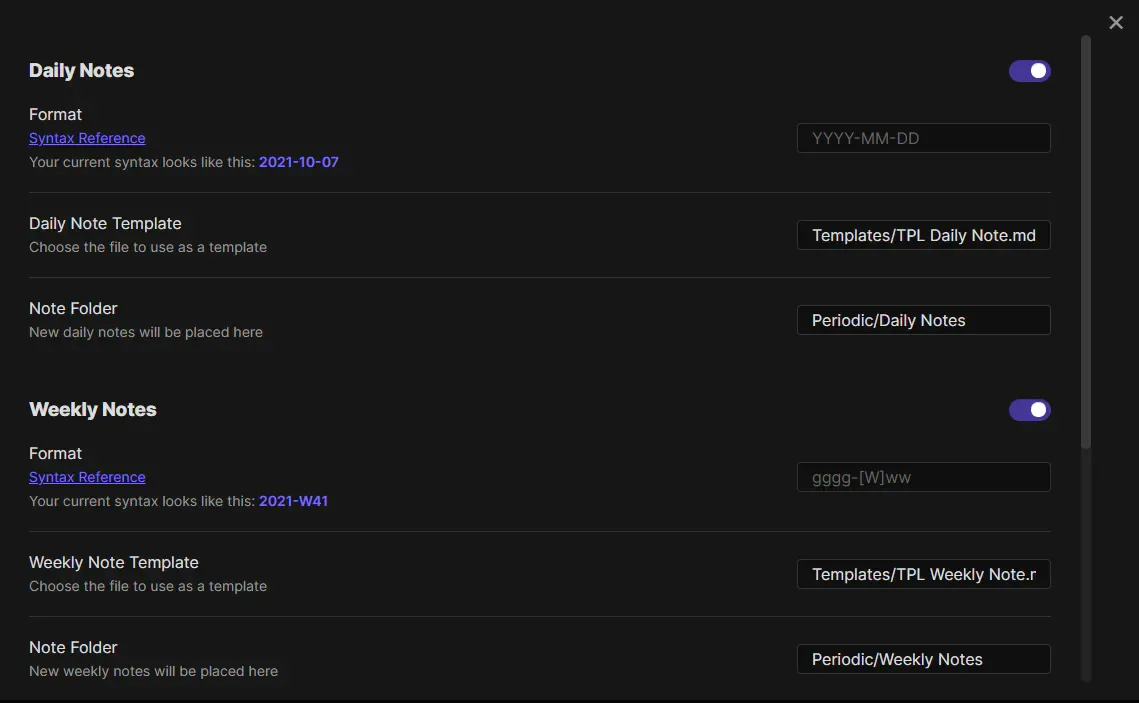
f there's interest, I'll write an article about the myriad of note-taking tools that exist out there.
Conclusion
In this second article of the series, I've made the link between journaling, knowledge management, and learning. Those go hand-in-hand. I've explained how periodic notes anchor our learnings within a specific context. Along with that, I've shared the templates, naming schemes, and tools that I use.
I've also touched on how journaling fits into my personal productivity system. In particular, how periodic notes/reviews help me stay on track and achieve my goals.
I sincerely hope that this article will be useful to you and that you'll consider experimenting with journaling, and maybe even joining our PKM community on Slack.
There's a lot more to know about Personal Knowledge Management (PKM). If you're interested in knowing more, then don't forget to subscribe to my newsletter.

That's it for today! ✨
References
- Why successful people take notes and how to make it your habit: https://www.lifehack.org/796333/take-notes
- Essentialism: https://www.amazon.com/Essentialism-Disciplined-Pursuit-Greg-McKeown/dp/0804137382?tag=dsebastien00-20
- Amara’s Law: https://fs.blog/2019/05/gates-law
- Obsidian: https://obsidian.md
- Obsidian Periodic Notes community plugin: https://github.com/liamcain/obsidian-periodic-notes
- Zettelkasten: https://en.wikipedia.org/wiki/Zettelkasten and https://www.dsebastien.net/2022-05-01-zettelkasten-method/
Go Further
 Sébastien Dubois
 Sébastien Dubois
 Sébastien Dubois
Want to go deeper?
Sébastien Dubois
About Sébastien
Ready to get to the next level?
Found this valuable? Share it with someone who needs it.