
Collective Intelligence and PKM: Why Your Notes Are Smarter Than You Think
What do ant colonies, Wikipedia, and your personal knowledge graph have in common? More than you'd expect. Your notes are a collective intelligence system — and when you compose them as context for AI, they become something far more powerful.

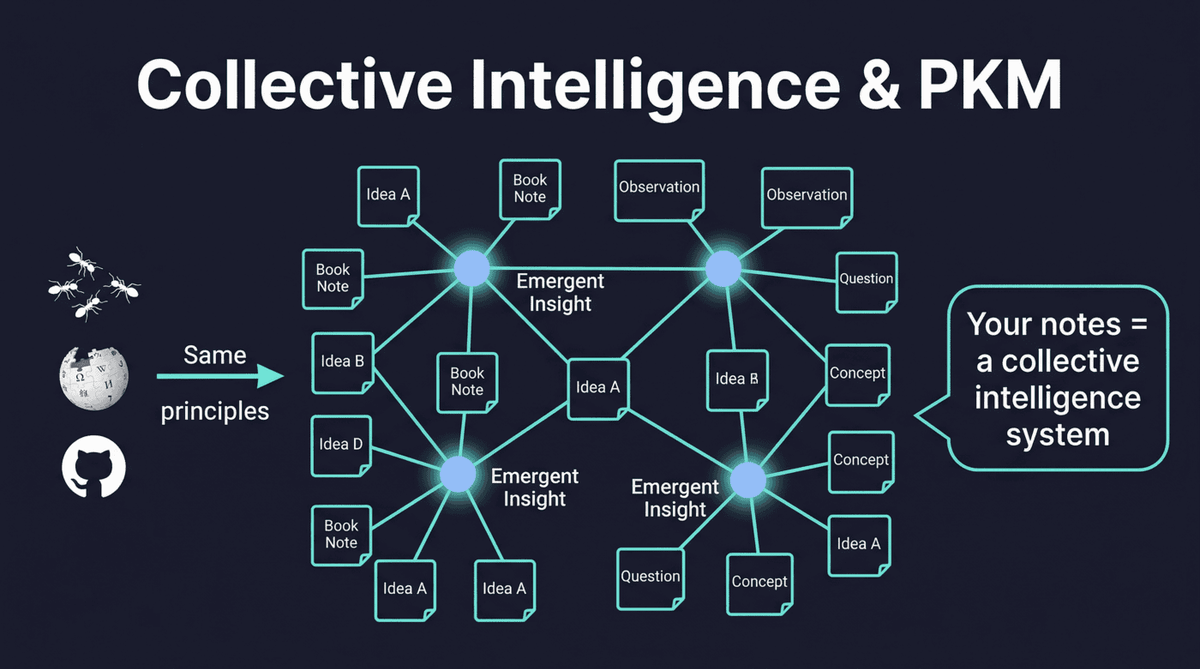
What do ant colonies, Wikipedia, and Obsidian have in common?
More than you'd expect. And I'm not kidding.
In this article, I want to explore how the principles of collective intelligence apply to Personal Knowledge Management (PKM). Understanding this can change how you think about your notes, your system, and the value of connecting ideas together. And with AI now in the picture, this matters more than ever, because your notes aren't just a thinking tool anymore. They're composable context. And that's where real leverage begins.
Introduction
We usually think of intelligence as something that lives inside a single brain. But some of the smartest systems in the world aren't individual minds. They're networks. Ant colonies solve complex routing problems. Wikipedia contains more knowledge than any individual could ever hold. Open source software, built by hundreds and sometimes even thousands of independent contributors, runs most of the internet.
This is Collective Intelligence: the shared intelligence that emerges from collaboration, collective efforts, and interaction among many participants.
A Knowledge Management system works on similar principles. Each note is like an independent agent/entity. It holds one idea, one perspective, one piece of knowledge. And when you connect them together, something bigger emerges. Something smarter than any single note; however long it is.
Let me explain why this matters for how you organize your knowledge.
What Is Collective Intelligence?
Pierre Lévy popularized the term in his 1994 book Collective Intelligence: Mankind's Emerging World in Cyberspace. Douglas Engelbart developed the related concept of "Collective IQ," which describes a group's capability to solve problems together. And James Surowiecki's The Wisdom of Crowds (2004) explored when and why groups outperform individual experts.
Under the right conditions, groups can be remarkably intelligent. Often smarter than the smartest individuals within them. Unfortunately, the opposite can also be true ;-)
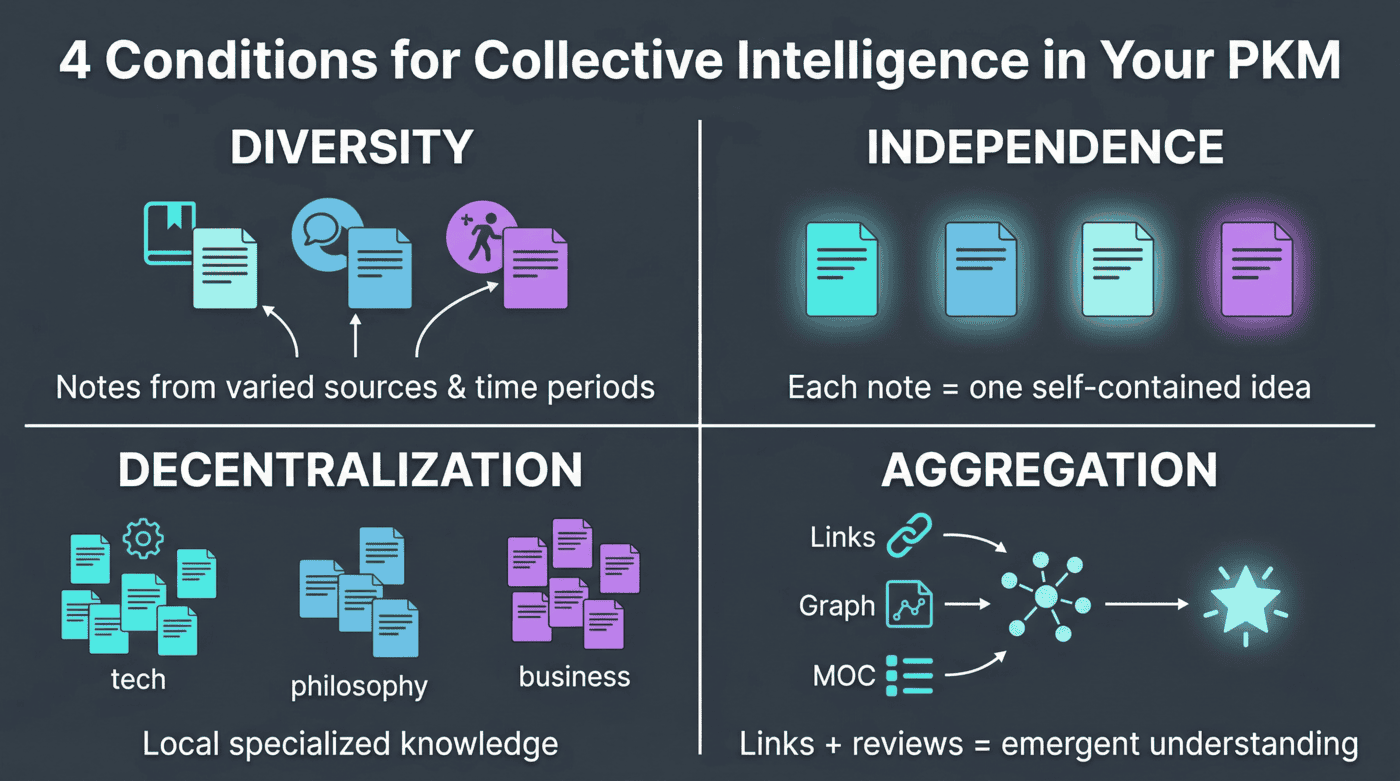
Collective intelligence doesn't just happen through. It requires specific conditions:
- Diversity of opinion: Different perspectives and information sources
- Independence: Opinions that aren't determined by those around you
- Decentralization: Local knowledge and specialization
- Aggregation: A mechanism to combine individual contributions into collective outcomes
Without these conditions, you get groupthink, echo chambers, and mob behavior. Not intelligence.
Your Knowledge Graph as a Collective System
Now, think about your knowledge base; your PKM system. If you're building a knowledge graph with linked notes (which I strongly recommend), each note represents a distinct perspective. A thought, an idea, a concept, an observation, a connection, a question, ...
When you have hundreds or thousands of linked notes, you're not just storing information. You're creating a collective intelligence system where your own ideas "interact" with each other.
Consider how this maps to Surowiecki's conditions:
Diversity: Your notes come from different sources, different time periods, different contexts. A note from a book you read last year sits next to an observation from yesterday. A technical concept connects to a philosophical one. This diversity is exactly what makes your knowledge graph valuable.
Independence: Each Atomic note captures one idea on its own terms. It doesn't depend on the notes around it. It stands alone. This independence means you can combine ideas freely without baggage. If you're a developer, you can think of it this way: each note is a pure function. No side effects, no hidden state. You can compose them in any order, in any combination.
Decentralization: Your notes contain local, specialized knowledge. One note knows about Spaced repetition. Another knows about "habit formation". Neither needs to know everything. But together, they cover more ground.
Aggregation: This is where your links; your Knowledge Graph (KG), and your review processes come into the picture. They're the mechanism that combines individual notes into collective understanding. Map of Content (MoC), Periodic reviews, Obsidian Bases, or even just browsing your graph. These are aggregation tools.
Why This Is Highly Relevant
Write More, Shorter Notes
Every new note adds a "voice" to your collective system. The more diverse perspectives you capture, the smarter your system becomes. But they need to be focused. Long, rambling notes don't contribute distinct perspectives. They create noise.
This is why Atomic notes matter so much. Each atomic note is a clear, independent contribution to your knowledge graph.
Connect Aggressively
The aggregation mechanism is critical. A thousand unlinked notes is not a collective intelligence system. It's a pile. It's noise. It's useless. The real values comes from connecting ideas across domains, across time, across contexts, ...
Every time you create a link, you're enabling a new pathway for insights to emerge. Don't be shy about it.
Embrace Contradiction
In a well-functioning collective intelligence system, conflicting views are an asset. They prevent groupthink. The same applies to your notes. If you read two authors who disagree about something, capture both perspectives. Don't resolve the tension prematurely. Let your notes hold the contradiction. Over time, your understanding will deepen precisely because you preserved that diversity.
Review and Resurface
Collective intelligence needs aggregation. In your PKM system, that means actively reviewing your notes. Periodic reviews aren't just about productivity and/or refreshing your memory. They're your chance to spot new connections, identify patterns, and let insights emerge.
I use weekly and monthly review processes for this. Every time I review, I find connections I didn't see before. It's like the system gets smarter on its own.
Real-World Examples of Collective Intelligence in Knowledge Work
Here are some real examples of collective intelligence principles applied to knowledge:
- Wikipedia: Open editing with consensus mechanisms. Thousands of contributors, each adding their perspective, governed by rules that aggregate contributions into something coherent
- Open source software: Distributed contributors working on shared codebases, using version control as their aggregation mechanism
- Stack Overflow: Questions and answers with community voting. The best answers rise to the top through collective judgment
- Shared Zettelkasten: Some communities are now experimenting with interconnected public note systems, where individual knowledge graphs can link to each other
Each of these works because they maintain the conditions for collective intelligence: diversity, independence, decentralization, and aggregation.
When Collective Intelligence Fails
It's important to understand how things can go wrong:
- Groupthink: When everyone in a group thinks the same way. In your PKM, this happens when you only capture ideas you already agree with, or when AI never contradicts you
- Echo chambers: When your information sources are too narrow. If all your notes come from the same three authors, your system lacks diversity
- Information cascades: When you follow trends blindly without thinking critically. "Everyone says X, so it must be true"
To avoid these issues with your knowledge base, you need to be intentional about finding and considering diverse perspectives. Read widely. Fight against cognitive biases. Capture ideas that challenge your current thinking. Your system will be smarter for it.
Collective Intelligence Meets AI: Composition as Leverage
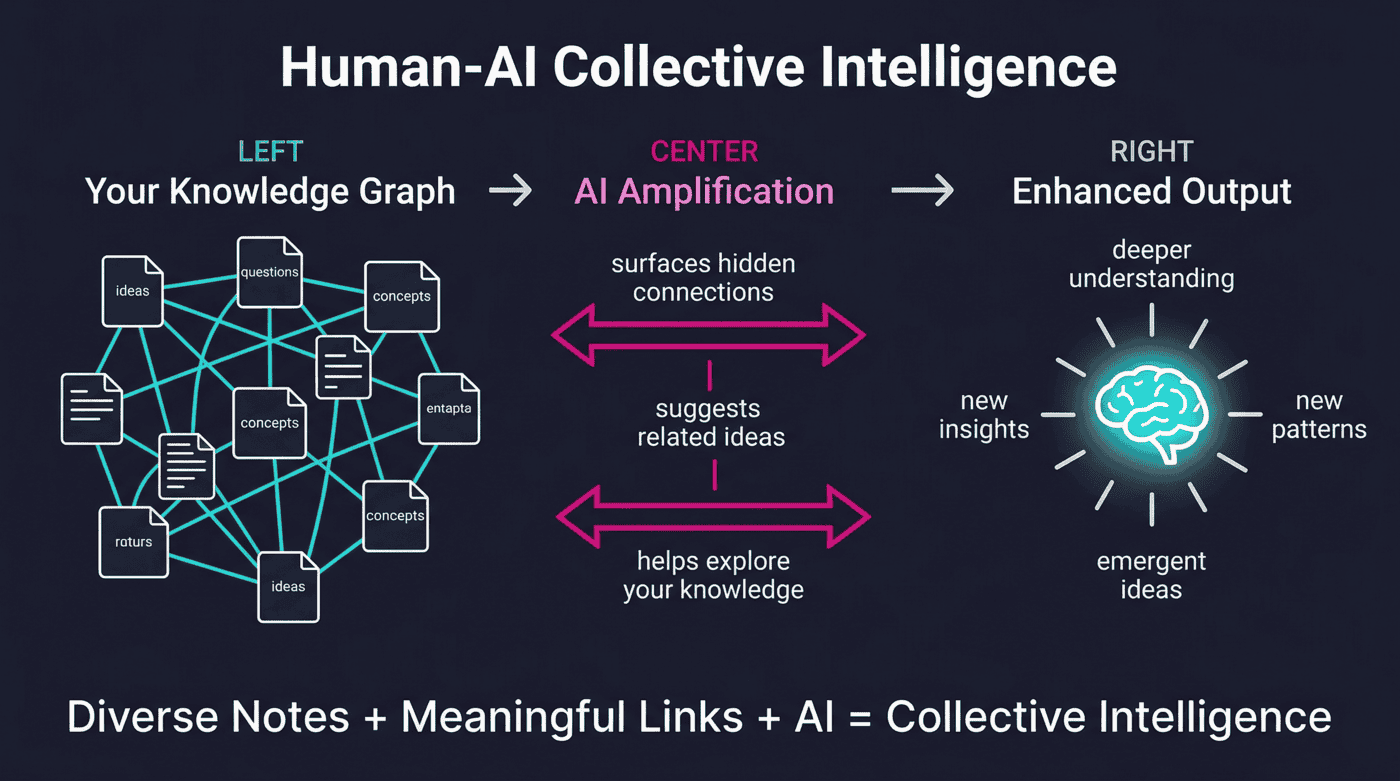
What I love about this combination is that it creates/enables something that goes beyond "just" a thinking tool. It creates a library of composable context for AI.
Your Notes Are Building Blocks
In software development, there's a powerful principle called composition: build complex systems from small, focused, reusable components. Don't write one monolithic program. Write small functions that each do one thing well, then combine them to create behavior that none of them could produce alone, in a more predictable and "solid" way.
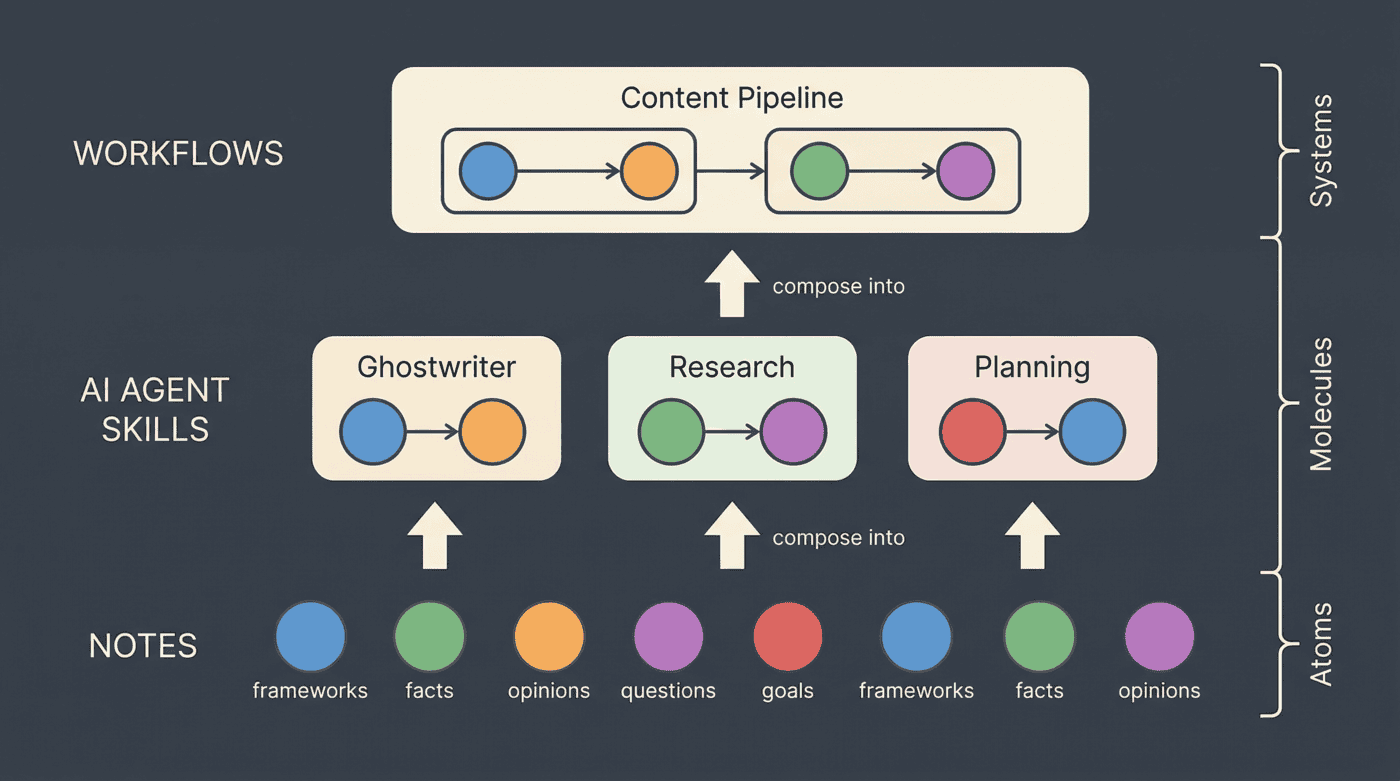
Atomic notes work the same way. Each note is a self-contained "unit of meaning". A concept, a framework, an opinion, a data point, a question. Individually, they're useful. But when you compose them (e.g., selecting specific notes, combining them, and feeding them as context to an AI), you unlock many powerful use cases.
This is fundamentally different from asking AI a question without giving it more data. When you compose/assemble your notes and use those as input for AI, the context that you provide AI is highly valuable. When you do that, AI doesn't (only) work from generic knowledge. It works from your knowledge. Your frameworks, your observations, your specific domain expertise, your circumstances, your goals, ... The output isn't generic anymore. It's grounded in what you actually know and think.
Not All Notes Play the Same Role
Here's a nuance that matters: when you compose notes as context for AI, the type of note changes what happens.
- Framework notes steer reasoning. Feed the AI your mental model for evaluating startups, and it will apply that lens to whatever you ask about
- Fact notes ground the output. They prevent hallucination and keep the AI honest about specifics
- Opinion notes inject your perspective. The AI adapts its voice and angle to match your thinking
- Question notes open exploration. They signal to the AI that you're looking for possibilities, not answers
- Goal/Plan/Project/Task notes give highly contextual information, enabling AI to help you make meaningful progress
The skill is not just about having lots of notes. It's about knowing which ones to compose together for a given task. A framework note + a set of fact notes + a specific question = a prompt that produces something genuinely useful. The same AI, the same model, the same prompt, but wildly different output depending on which notes you include as context.
This is why atomic notes matter even more with AI. A 5,000-word brain dump is hard to compose with anything. But a clean, focused note about one concept? You can combine it with anything else. That's the whole point of composition.
The Three Layers of Leverage
When you compose your notes as AI context, three things happen:
Quality improves first. This is the foundation. AI output with your notes as context is categorically better than without. It's not just "slightly more relevant." It makes a world of difference. Instead of generic advice, you get output that sounds like it came from someone who actually understands your situation. Because, in a sense, it did. The AI is reasoning through your own accumulated knowledge.
Speed follows. When the quality of the first output is high, you stop playing ping-pong with the AI. No more "that's not what I meant" and "you're absolutely right" back-and-forth. You compose the right context, ask the question, and get something usable on the first try. What used to take an hour of iterating now takes minutes. This compounds, and enables you to create more leverage with AI.
Scale becomes possible. With quality and speed in place, you can tackle things that were previously impossible to do alone. Write a deep analysis of a topic by composing your notes on it with your writing style notes. Have an AI agent review your work using your own principles as its evaluation criteria. Generate content that sounds like you because it's literally built from your thinking. Before long, you end up like me, with dozens of parallel AI discussions, each leading to valuable creations.
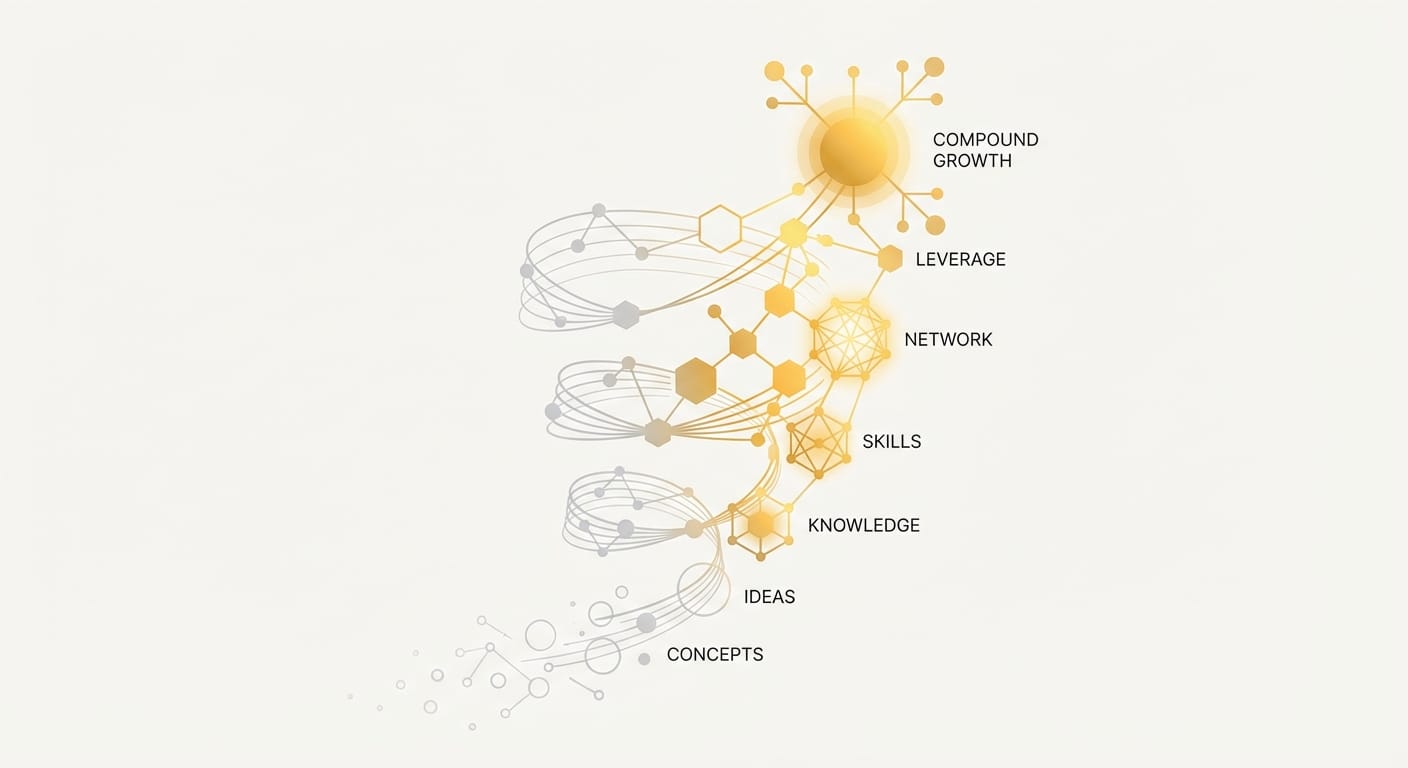
Each note you write IS an investment in future leverage. It's not just something you might re-read someday. It's a building block that can be composed into an infinite number of contexts.
From Collective Intelligence to Agentic Knowledge
I've written about how I use AI with my Obsidian vault every day, and this collective intelligence framing is exactly why it works so well. The AI doesn't replace your thinking. It amplifies it by helping you aggregate and connect what's already in your system.
 Sebastien Dubois
But it goes further. When you give AI agents access to your knowledge graph, they don't just answer questions. They become an extension of your collective intelligence system. They can combine notes you'd never think to combine. They can apply a framework from one domain to a problem in another. They can compose context on the fly, assembling exactly the right mix of your ideas for whatever task you're working on.
This is what I call Agentic Knowledge Management. The next evolution of PKM. Your notes become the API for your thinking, and AI agents are the consumers of that API, composing your ideas in ways that create real, compounding value.
 Sebastien Dubois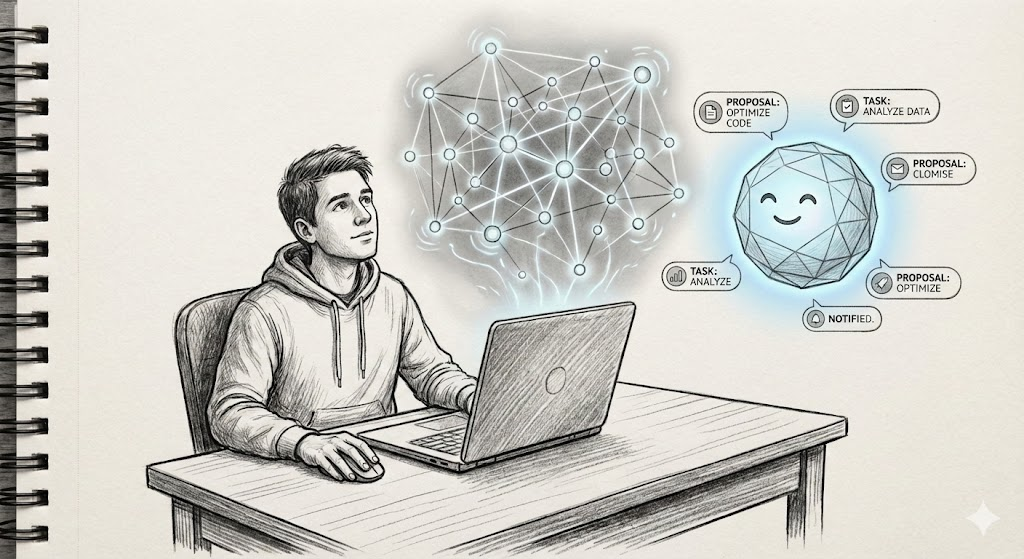
How to Apply This Today
Here are practical steps you can take right now:
- Audit your note diversity: Are your notes coming from varied sources? Different books, conversations, experiences, domains? If not, branch out; open your mind to different ideas
- Capture information about your processes, your plans, your goals, your writing style, etc: This will all help AI better help you
- Check your linking habits: Are you connecting notes across different topics? Or do your links only go between closely related notes? Cross-domain links are where the real value lies (TIP: Ask AI to let you know about connections you are missing!).
 Sebastien Dubois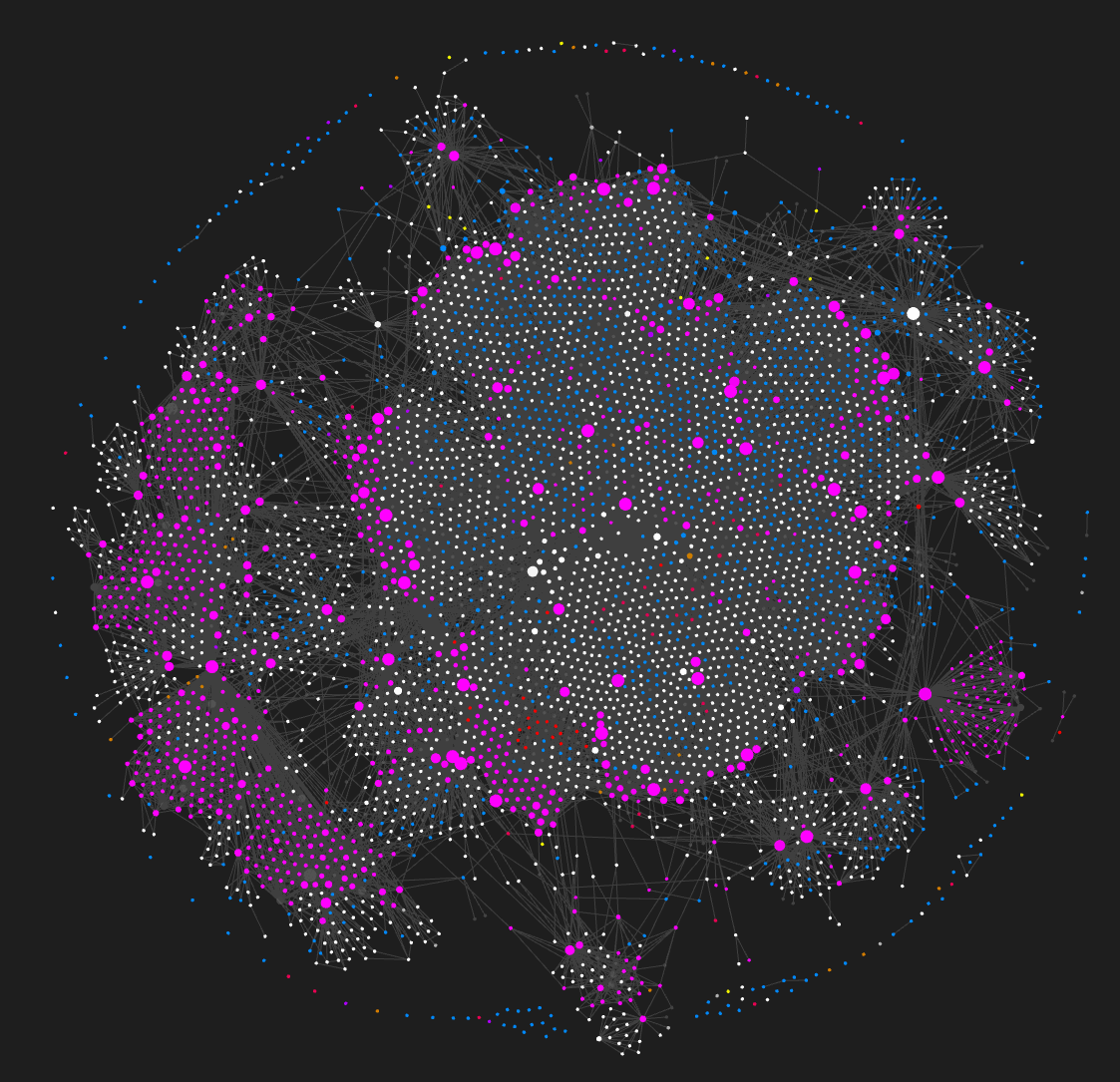
- Capture disagreements: When two sources contradict each other, capture both. Don't resolve it. Let your system hold the tension
- Schedule reviews: Set up weekly or monthly reviews where you browse your graph, read old notes, and look for new connections
- Start small: You don't need 90,000 notes like Luhmann. Start with 10 well-linked atomic notes. Then 50. Then 100. The collective intelligence emerges naturally as the system grows. Don't pressure yourself to reach a certain number, but consider that the value of your system compounds as it grows, and there's a cold start problem.
 Sebastien Dubois
- Compose context deliberately: Next time you use AI, don't just ask a question. Assemble 3-5 relevant notes as context first. Notice the difference in output quality. Then experiment: swap one framework note for another and see how the output changes. This is the skill of composition, and it gets better with practice
- Write notes with composition in mind: When you capture an idea, ask yourself: "Could I combine this with other notes later?" If a note tries to say too much, split it. The more composable your notes are, the more leverage they create
Over time, as you dive deeper, you'll realize that AI Agent Skills are the perfect way to compose notes and instructions to achieve some goal (e.g., writing an article, analyzing sales, reviewing a project, planning your day, ...). And in fact, AI agent skills can actually be composed themselves, which means you'll then be creating higher-level compositions, each composed of specific contexts. It's a bit like atoms combining to form molecules, themselves combining to form a larger system, etc. Fun times!
Conclusion
Your PKM system is more than a storage tool. When you build it right, that is with diverse, independent, focused notes connected through meaningful links, it becomes a collective intelligence system. Your ideas interact, combine, and produce insights that no single note could generate alone.
And with AI, the leverage you get from the simple practice of taking notes is astounding. You connect ideas, combine notes to create skills, combine skills to automate entire workflows, and end up with a system whose value keeps compounding as your knowledge base grows and as Large Language Models (LLMs) evolve.
Start treating your notes like a community of ideas. Give each one a clear voice. Connect them generously. Compose them deliberately. And watch what emerges.
That's it for today! ✨
Go Further
 Sébastien Dubois
 Sébastien Dubois
 Sébastien Dubois
 Sébastien Dubois
 Sébastien Dubois
 Sébastien Dubois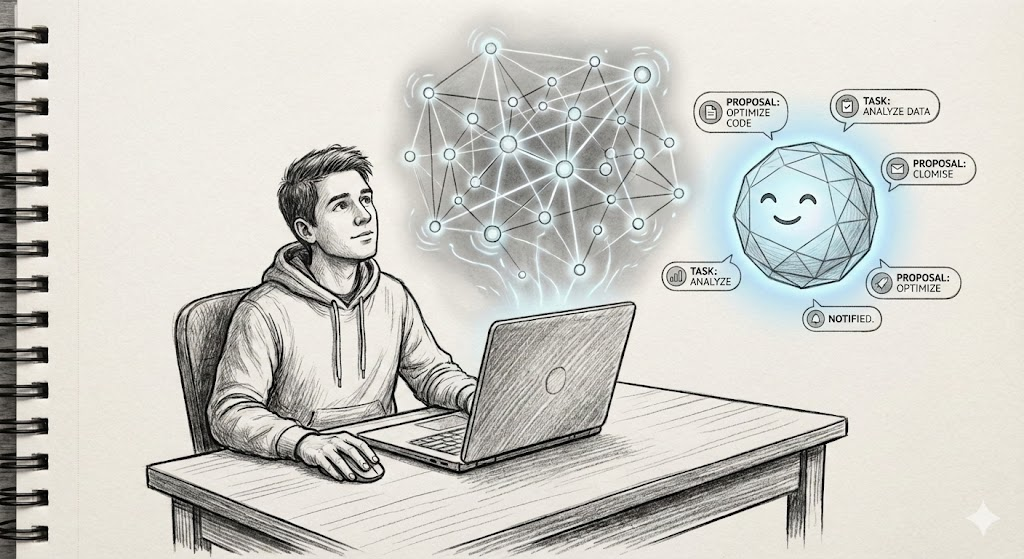
Want to go deeper? Check out the Obsidian Starter Kit:
Sébastien Dubois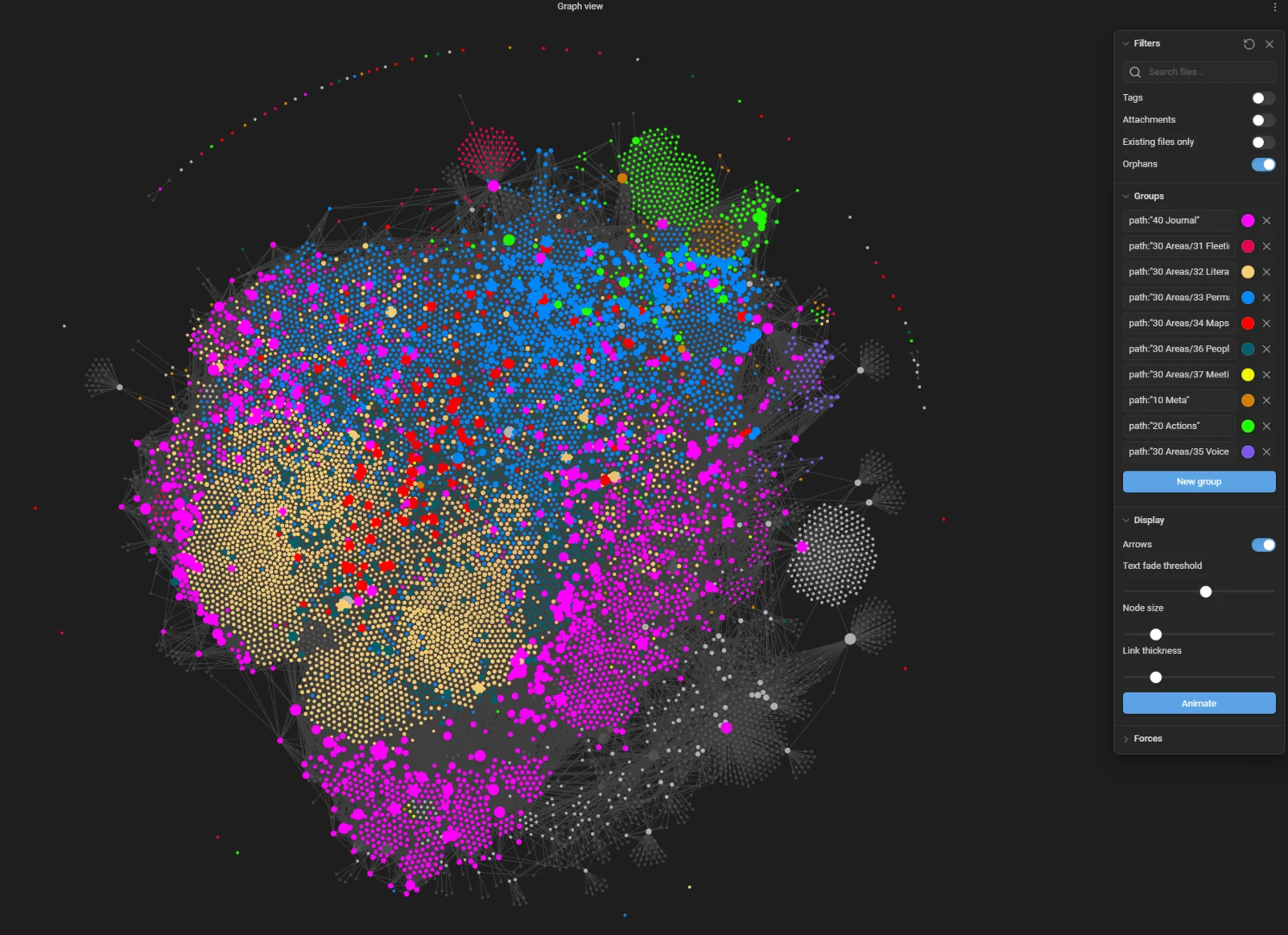
About Sébastien
I'm Sébastien Dubois, and I'm on a mission to help knowledge workers escape information overload. After 20+ years in IT and seeing too many brilliant minds drowning in digital chaos, I've decided to help people build systems that actually work. Through the Knowii Community, my courses, products & services and my Website/Newsletter, I share practical and battle-tested systems.
I write about Knowledge Work, Personal Knowledge Management, Note-taking, Lifelong Learning, Personal Organization, Productivity, and more. I also craft lovely digital products and tools.
If you want to follow my work, then become a member and join our community.
Ready to get to the next level?
Want to use AI as a real thinking partner?
- 🤖 AI Ghostwriter Guide — Make AI write like you
- 🧠 AI Master Prompt Workshop — Craft prompts that actually work
- 🎙️ Knowii Voice AI — Privacy-first voice-to-text powered by AI
- 🎯 Join Knowii — AI workshops + community + all courses
Found this valuable? Share it with someone who needs it.