
Don't keep AI out of your vault. Put it in charge of the plumbing.
The standard 'keep AI away from your vault' advice solves the wrong problem. AI doesn't belong outside your knowledge base; it belongs inside, in charge of the plumbing while you stay in charge of the thinking. Here's the mindset and the structure that make that work.



AI handles the plumbing, you do the thinking. Everything else follows from that.
In this article, I want to push back on a piece of advice that I've stumbled upon a few times already: "Don't let AI touch your knowledge base." I get the idea. I really do. But I think it's wrong, and I want to convince you that AI belongs INSIDE your vault, with the right mindset, approach and structure.
Introduction
The concern goes roughly like this. AI generates slop that pollutes your notes. AI summaries replace the thinking that makes knowledge actually stick. AI does the connecting work that's supposed to be YOURS to do. After a while, you can't tell what's yours and what's the machine's, and search becomes noise. Worse, you lose the ability to think!
All of that is real to some extent. But the conclusion ("keep AI out") is the wrong fix for the right problem. The actual fix is a different mindset, a different architecture, and a different definition of what AI is for and how to leverage it properly.
That's what I want to lay out here.
TL;DR
- The "keep AI out of your vault" advice solves the wrong problem. The real problem is AI as a replacement for thinking. The fix is AI as an augmentation layer.
- Your knowledge base is the most valuable input you can give to AI. It's YOUR context, YOUR thinking, YOUR sources. The more it grows, the more useful AI becomes, and the bottleneck shifts from capture to review.
- AI slop can be heavily reduced by design, not by avoidance.
- A rich vault makes AI dramatically more useful. AI without context is generic. AI on top of YOUR vault is yours.
- Portability and ownership beat vendor lock-in. Your vault stays YOURS regardless of which AI tools you use today, next year, or never again.
- The Obsidian Starter Kit v4 I just released was built around exactly this principle. LLM Wikis are the concrete pattern that makes AI-generated content safe to live in your vault: provenance, confidence, and a graduation path into the permanent core.
 Dwayne Appleby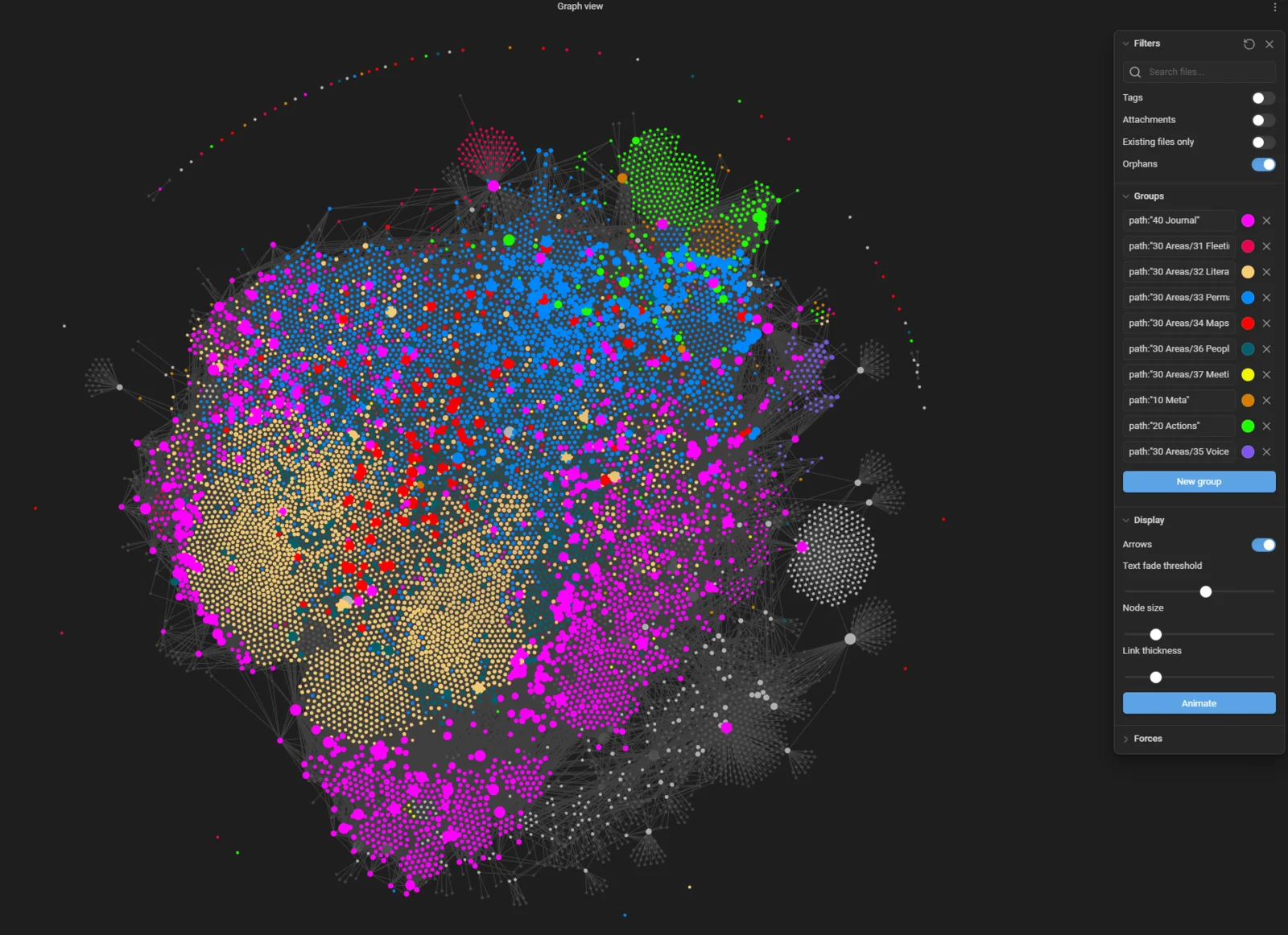
The Reflex Is Understandable. The Conclusion Is Wrong.
The fear is grounded. People hook Claude or ChatGPT up to their vault, prompt "generate 200 notes about productivity", and end up with a graph full of confident-sounding garbage. That's what you see everywhere on social media. It's super easy to do, and it's completely meaningless and useless.
But there's worse. Some people completely replace their own thinking with AI and slowly forget what they actually believed. The vault becomes an AI landfill. The reader becomes a passive consumer of their own knowledge base.
So the reflex is: don't let it in.
But that's a false dichotomy. The choice isn't:
- A: pristine AI-free knowledge base with all-human thinking
- B: AI-polluted knowledge base with no original thought left
The real choice is:
- C: a vault YOU built, where the structure decides what AI touches and what stays yours; AI handles the plumbing, you keep the thinking.
Option C is where the right balance can be found. It requires a mindset shift and a bit of discipline. Once you make it, the slop problem and the atrophy problem both shrink dramatically. Let me show you how.
The Augmentation Principle
I built the Obsidian Starter Kit v4 around one core idea:
AI handles the plumbing. You do the thinking.
That's the "augmentation principle". Your brain stays in the driver's seat. AI just takes the tedious, repetitive, low-value work off your plate so you can spend your energy on the stuff that actually matters: deciding what to focus on, writing your own arguments, connecting your own ideas, making your own calls.
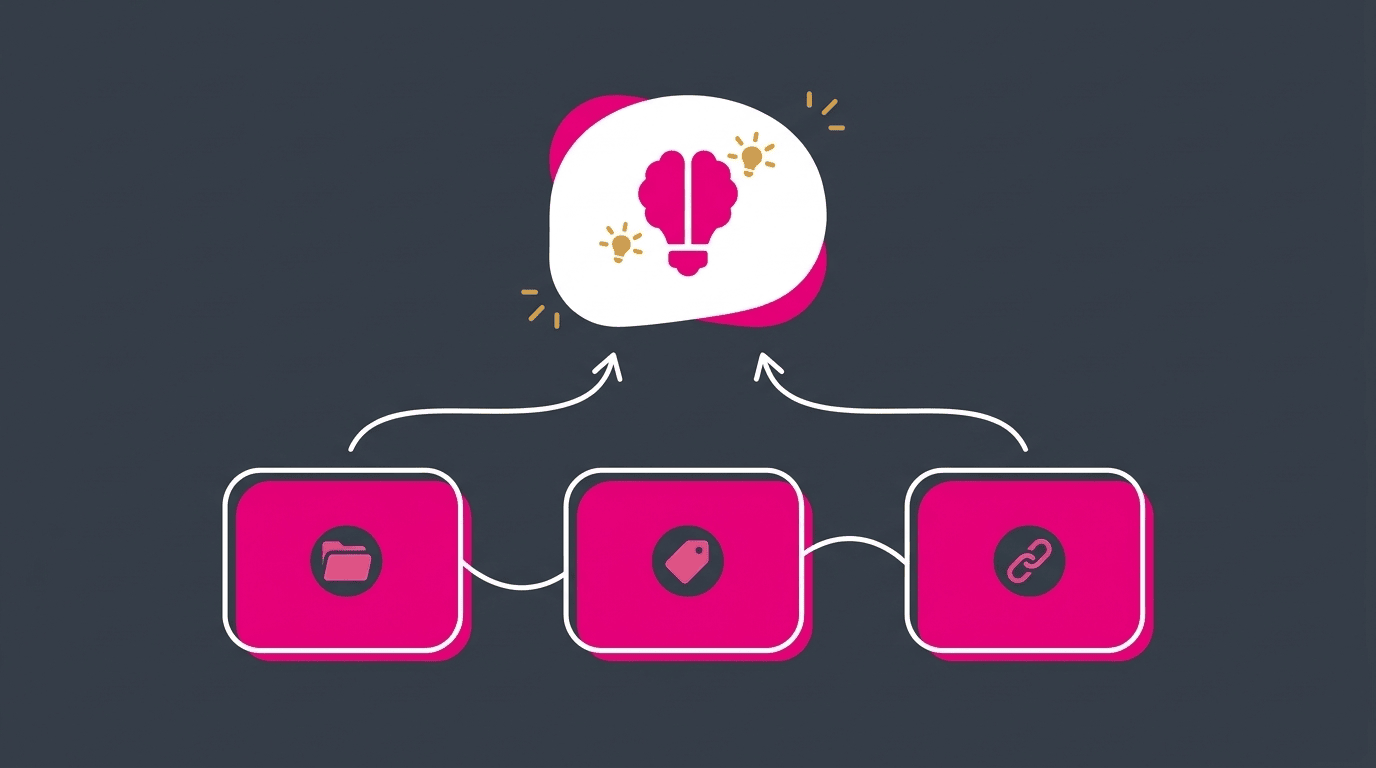
Think of it like a great assistant. A great assistant doesn't write your strategy for you. They book the meetings, prep the documents, send the follow-ups, file the receipts. They handle everything that doesn't require YOU specifically. You stay in the driver's seat. You just drive better because someone competent is handling the rest.
That's what AI should be inside your vault.
Three rules flow from this:
- You decide what matters. Every meaningful judgment call stays with you. AI proposes; you dispose.
- AI handles the tedious. Filing, tagging, link-fixing, formatting, drafting from your notes, repetitive data entry. The stuff that's not creative work and never was.
- Provenance and isolation prevent slop. AI-generated content is marked as such and easily identifiable (e.g., using specific tags, folders, dedicated note types, etc) so you always know what's machine-produced versus what's yours.
Get those three right, and the "don't let AI in" advice becomes unnecessary.
The Compounding Knowledge Base
There's a strange irony in the "keep AI out" position. The thing it's trying to protect (your knowledge base) is exactly what makes AI useful TO YOU SPECIFICALLY.
When you use ChatGPT cold, you're using a generic AI on generic prompts. The output is generic. It's the average of everyone else's writing on the topic.
When you use AI on top of YOUR vault, it's quite different. The AI now has access to YOUR thinking, YOUR sources, YOUR projects, YOUR notes from the last few years. It can pull from YOUR research, reference YOUR own arguments, work with YOUR voice. Suddenly it's not generic. It's yours.
Also, link density goes up; AI suggests connections you'd never make manually, and your graph gets denser over time. Source provenance scales; every new literature note carries its origin without you having to remember. The capture friction disappears, and the new bottleneck becomes your review capacity. Friction moves to where it actually belongs: to the work that requires judgment, not to the typing.
The more knowledge you've captured and organized, the more useful AI becomes to you and ONLY to you. The more useful AI becomes, the faster you can build on what you already have.
The value of the whole compounds.
Portability Beats Vendor Lock-in
People worry about vendor lock-in with AI. But if your knowledge lives in local Markdown files in YOUR vault, you're never locked in. You can swap models. You can swap providers. You can stop using AI entirely. Your vault stays YOURS. That's ownership, portability, security, and control all at once.
This is also why I keep telling people to grow their vault for a lifetime. Note-taking apps will come and go. AI Models will come and go. Companies will rise and fall.
But your knowledge base is an asset that compounds independently of it all. AI is just a force multiplier on top of that asset. It is not the asset itself. The knowledge base is.
The AI Slop Problem Is Solved by Design, Not by Avoidance
OK so what about the actual slop problem? It's real. AI does produce garbage if you let it. The answer isn't to keep AI out. The answer is to use AI in a smarter way.
A few patterns I use:
- Tag everything AI-generated with a clear marker so it's visible at a glance and filterable in search. You always know what came from your hand and what came from the machine (e.g., with a simple
ai_generated: truemetadata property) - Isolate AI-heavy content in dedicated folders and/or note types. Don't sprinkle it everywhere.
- Require human review before anything gets promoted to a permanent note (the curated, hand-edited core of your knowledge base; the notes you'd defend if asked). AI can draft. You decide what survives.
- Track sources and confidence on AI-assembled knowledge. If a claim is uncertain, show it. If a source is weak, mark it.
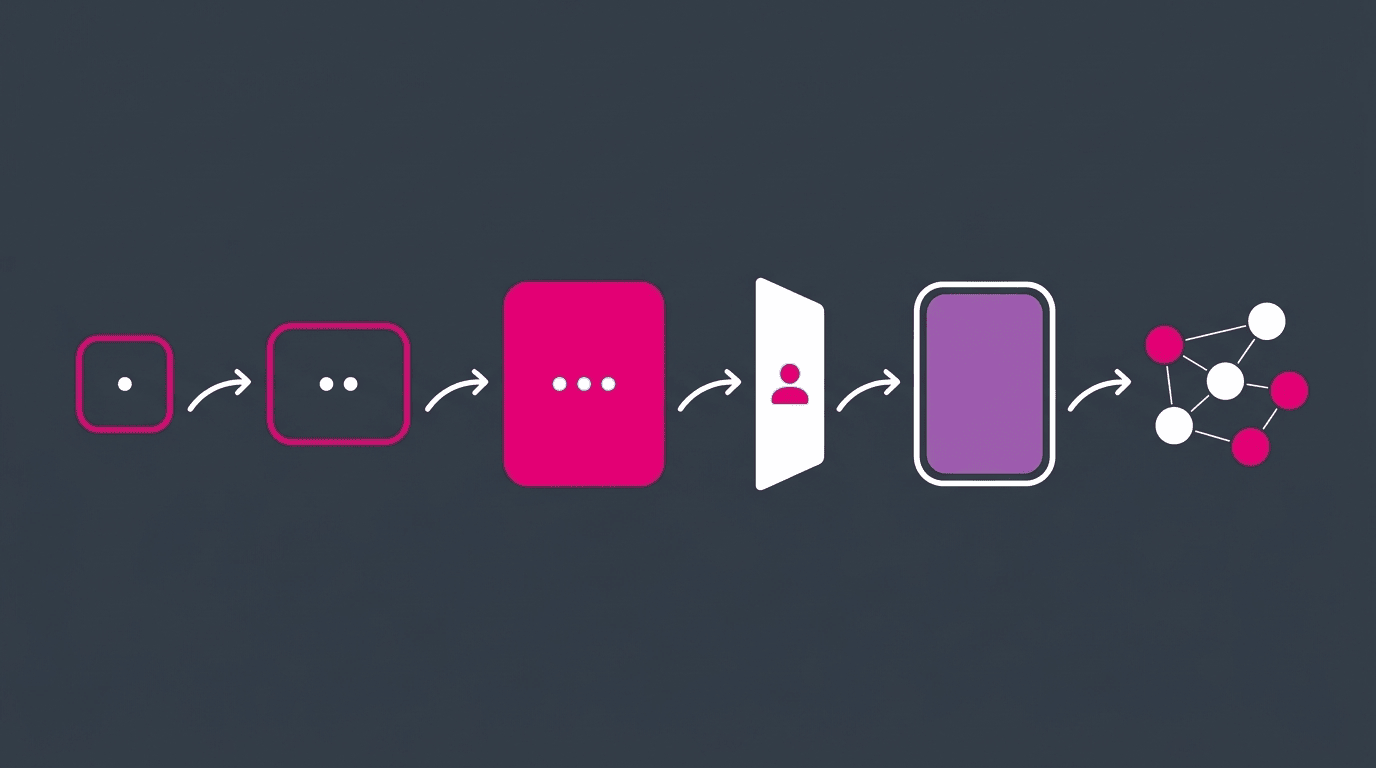
In the Obsidian Starter Kit v4, this is exactly how LLM Wikis work (cfr LLM Wiki System). An LLM Wiki is a structured knowledge base, partly AI-assembled, that lives in its own dedicated space inside your vault. Every article has:
- A maturity level (stub, growing, mature, deep)
- A confidence score (so you know how much to trust a claim)
- Source provenance for every claim
- A graduation path: when an article is mature and trustworthy enough, you can promote its concepts into proper permanent notes, with your own review and edits
In that system, AI-generated knowledge has a clear lifecycle. It starts in its own container, gets refined, gets validated, and only the best stuff graduates into your "real" notes. Your hand-curated permanent notes never get polluted. Your search never gets noisy. You always know the lineage of any idea.
Using AI is fine if you have the right mindset and design structures and habits to protect your own thinking.
What I Actually Use AI For (Inside My Vault)
A short, concrete list. This is what daily AI-in-the-vault actually looks like for me right now.
- Knowledge processing: turning articles, books, GitHub repos, and YouTube videos into proper literature notes; atomizing rich brain dumps into clean permanent notes; building LLM Wikis on topics worth exploring deeply.
- Thinking sparring: premortems on plans I'm about to act on, red-teams on arguments I'm about to publish, steelmans for positions I disagree with, contradictions between notes I wrote months apart.
- Discovery: surfacing forgotten notes that are suddenly relevant; finding unexpected connections between domains; suggesting links between notes that aren't yet connected.
- Maintenance: filing notes, harmonizing tags, fixing broken links, applying and improving templates, customizing styles, validating notes against my type definitions.
- Personal augmentation: tracking my health data and spotting patterns; planning and reviewing my sports activities (currently training for a marathon); improving my CRM; building tools, apps, and websites; preparing courses, slides, videos, marketing material; publishing across platforms; reviewing my progress against my goals; identifying my own patterns (good and bad).
- Creation: drafting articles from scattered notes, writing newsletter sections from this week's discoveries, repurposing one piece into many formats, generating image prompts and visuals.
Those are but a few examples. The gist of it is that almost every AI discussion starts within my knowledge base, leveraging my notes as initial context, and leveraging AI Skills and AI Agents I've built inside of it.
In every single one of those, I'm still the one making the decisions. AI just handles the parts that don't deserve my full attention. The thinking, the writing, the connecting? Still me. Always. That's the whole point.
What This Doesn't Look Like
To be clear, here's what AI inside your knowledge base should NOT look like:
- Auto-generating 200 notes on a topic and calling that a knowledge base (at best, it's an LLM wiki; at worst, it's just a pile of useless junk)
- Letting AI summarize everything you read and never going back to the source
- Replacing your own writing with AI drafts you don't even revise
- Using AI to think for you instead of with you
- Mixing AI output with your own notes with no way to tell them apart
If you're doing any of that, you've drifted into replacement. That's the failure mode the "keep AI out" advice is trying to prevent.
The fix isn't avoidance. The fix is structure, discipline, and the right mindset.
How to Start Without Polluting Your Vault
If this resonates and you want to try it, here's the only progression I recommend. Start simple, in this order.
Start with maintenance. Use AI to fix tags, file notes, clean links. Pure plumbing, very limited risk.
Once you trust the patterns, add literature notes from articles, books, and videos (with review and edits; always). Then create a dedicated container for AI-assembled content (an LLM Wiki, a separate folder, a marked note type, whatever your structure allows) so anything AI touches stays visible and isolated. Tag everything AI-produced so search and filters can show or hide it on demand.
Only promote AI-assembled content into your permanent notes once you've reviewed, edited, and made it yours. Finally, use AI for thinking sparring (premortems, steelmans, finding contradictions in what you already wrote). Let it challenge you. Never let it conclude for you.
If you're using the Obsidian Starter Kit v4, this whole progression is wired in; there are dedicated skills for tag harmonization, link densification, literature-note ingestion, LLM wiki creation and graduation, thinking sparring (premortem, red-team, steelman, contradict, and friends), and a ton more.
The system you rely on should do the heavy lifting so you don't have to enforce it manually and so you can focus on what matters more: thinking more deeply!
Going Further
If you want a knowledge system that's already built around the augmentation principle, with LLM Wikis, a deep agent system, hundreds of AI skills, pre-defined note types and templates, etc. Then the Obsidian Starter Kit might be for you, because it's exactly that. It's a battle-tested system that is clearly organized, rock-solid, maintainable, scalable, and fully AI-enabled.
👉 Grab the Obsidian Starter Kit v4 and get a vault that respects YOUR thinking while letting AI handle the plumbing.
🔗 https://www.store.dsebastien.net/product/obsidian-starter-kit
If you want more of this, my newsletter is where I go deeper on PKM, AI integration, and how to build systems that actually scale.
If you'd rather see what real notes look like before deciding anything, my public notes are free to browse. Thousands of them. All built with this exact philosophy.
You can also get the Obsidian Starter Kit as a bonus by joining the Knowii Community, a place where we explore deeply valuable ideas together.
 Sofia
Sofia
Conclusion
AI is not the enemy of Knowledge Management. AI as a replacement for thinking is. The distinction matters a LOT.
Walling AI off from your vault feels protective, but it also walls off everything AI can actually do for you: faster processing, sharper thinking, less tedium, more time for the work that's actually yours. You're protecting the wrong thing.
Your knowledge base is the most valuable context you have. Build with the augmentation principle. Let AI handle the plumbing. Do the thinking yourself. That's the combo.
That's it for today! ✨
About Sébastien
I'm Sébastien Dubois, and I'm on a mission to help knowledge workers escape information overload. After 20+ years in IT and seeing too many brilliant minds drowning in digital chaos, I've decided to help people build systems that actually work. Through the Knowii Community, my courses, products & services and my Website/Newsletter, I share practical and battle-tested systems.
I write about Knowledge Work, Personal Knowledge Management, Note-taking, Lifelong Learning, Personal Organization, Productivity, and more. I also craft lovely digital products and tools.
If you want to follow my work, then become a member and join our community.
Ready to get to the next level?
Since you're interested in Obsidian:
- 🚀 Obsidian Starter Kit — Skip weeks of setup with 40+ templates
- 🎬 Obsidian Starter Course — Master Obsidian in 2+ hours
- 📚 KM for Beginners — 10+ hours of structured video lessons
- 🎯 Join Knowii — Community + ALL courses & tools
Found this valuable? Share it with someone who needs it.